By Qwinn Selmer-Spong, University of Denver, majoring in Kinesiology, 2028 with supervision from Gina Inglese, MS, OTR/L, CCTS-I, CSOT.
Pelvic floor therapy is an area of therapy focused on your pelvic region. This includes reproductive health, bowel health, sexual health, and bladder health is often done by a physical therapist (PT) or an occupational therapist (OT). At Anxious Pelvis, the provider is an occupational therapist who specializes in pelvic floor therapy. They focus on holistic care that is trauma-informed and consent-forward. This is extremely important in pelvic floor therapy because, for conditions like vaginismus, there are mental components needed to treat the patient.
The Anxious Pelvis
The Anxious Pelvis is owned by Gina Inglese, MS, OTR/L, CCTS-I, CSOT, who graciously took me under her wing and allowed me to shadow and intern for around 15 weeks. Before this internship, I knew very little about pelvic floor therapy, and it caught my interest because of the care she took for women's health. At the end of my internship, I discovered that pelvic floor therapy is for everyone: men, women, non-binary individuals, and other gender identities. This company has allowed me to see how many lives can be changed by pelvic floor therapy. Every single individual I talked to who had participated in pelvic floor therapy told me it gave them hope in a world of chronic pain. They never had dreamed of a life without pain. This inspired me to pursue this internship, and I am so grateful for this path I have begun on.
What is occupational therapy?
What exactly does this job entail? According to the American Occupational Therapy Association, it aids in enabling people of all ages to participate in daily living. They promote health, well-being, and participation while being as independent as possible. They can work in schools, the community, hospitals, homes, and other settings. The field is so vast and can be defined differently by professionals within the field. The common goal of all occupational therapists is to focus on improving your wants and needs in your daily life. That includes anything meaningful that the patient wants to participate in their life. This can include recreation, working, volunteering, relationships, and all other activities of daily life.
What is the pelvic floor?
During my internship, I was asked this by my peers a lot. The general population does not know what the pelvic floor actually consists of or what therapy can look like surrounding the area. The pelvic floor consists of muscles and connective tissues that support your organs in the pelvis. This can include the bladder, bowel, and reproductive organs. The pelvic floor is a bowl shape that holds these organs in place. The pelvic floor focuses on the “5 S’s”. The five S’s include support, sphincteric, sexual, stability, and sump pump.
Support to the internal organs, including the bladder, uterus, and rectum. Your pelvic floor works in a hammock shape to support gravity and pressure.
Sphincteric function controls the opening and closing of sphincters such as the anus and urethra to avoid a leaky bladder and have proper bowel movements.
Sexual function allows for penetration and contraction to assist with arousal, orgasm, and fertility
Stability includes working with the diaphragm, abdomen, and back muscles to stabilize the body during movements of daily life.
Sump pump involves the coordination of the diaphragm and pelvic floor to help pump blood and lymphatic fluid through your body to the heart.
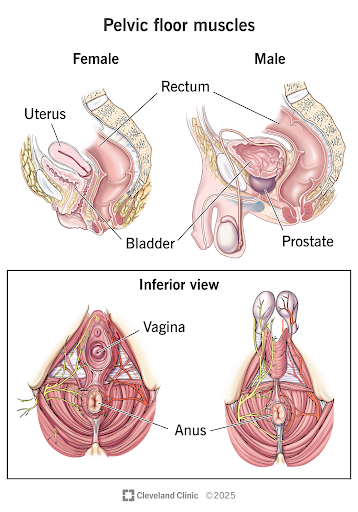
Pelvic Floor Muscles Illustration
Left: Anatomy with vaginal canal and uterus.
Right: Anatomy with penis and prostate
Top: View as if body was cut in half, looking from the side
Bottom: View of the muscles as if looking directly onto the pelvic floor.
Cleveland Clinic. (2025). Pelvic Floor Muscles. https://my.clevelandclinic.org/health/body/22729-pelvic-floor-muscles
What can pelvic floor therapy address?
Pelvic floor therapy can address so much more than the general population thinks, and it might just be helpful for you! Some things we address at Anxious Pelvis include:
Pain with intimacy
Pain with insertion (including tampons)
Low back pain
Bladder frequency
Bladder leaking
Bowel movement concerns
Tailbone Pain
Preparing for surgery (e.g., hysterectomy, bottom surgeries, hernia repair, C-section)
Urinary incontinence
Erectile dysfunction
And more!
What are some treatment methods?
Talk therapy
Nervous system regulation training
Pain management skills
Education about pelvic floor muscles and their functions
Bowel and bladder habit training
Pelvic tool training (such as dilators and pelvic wands)
Manual work
Soft tissue mobilization
Myofascial release
External and/or internal trigger points (vaginally and rectally)
Visceral mobilization
Scar tissue management
Stretches and strengthening
Breath mechanics
Core engagement skills
Coordination and functional movement training
And so, so, so many more! Click here to learn more about a typical treatment at the Anxious Pelvis.
How do I become a pelvic floor therapist?
Below are some steps to become a pelvic floor therapist. I will be focusing on the occupational therapy pathway to become a pelvic floor therapist.
Step 1: Complete your undergraduate degree
Often, occupational therapists complete a bachelor's degree in kinesiology, health sciences, biology, psychology, or any related field. The most important part is to look up the prerequisites of your desired program to ensure you have everything you need to get into occupational therapy school. Another pathway one may choose is an OT assistant, in which you must complete an associate degree.
Step 2: Apply to OT school and complete the program
There are so many incredible OT schools that allow you to get hands-on experience and try out all different types of occupational therapy niches. Occupational therapists can complete a Master of Science in OT (MSOT) or a Doctor of OT (OTD). To complete your MSOT or OTD, it will take 2-3.5 years that includes clinical experience and education.
Step 3: Pass your national board exam and get state licensure
Similar to many allied health professions, you need to pass a board exam to ensure you are qualified to practice. For occupational therapy, this is the National Board for Certification in OT exam. For any state you plan to practice in, you must additionally gain licensure in this state.
Step 4: Complete introductory coursework
Unfortunately, in occupational therapy school, they only provide limited training on the pelvic floor; therefore, additional education is essential. This is essential to be able to do internal work and manual therapy in pelvic health. Entry level options for coursework may be found through the Functional Pelvis, Herman and Wallace, Essential Pelvic Health, and more.
Step 5: Gain clinical experience and mentorship
With any career, hands-on clinical experience is so important. Treating patients can help solidify the work you learned in both school and in continuing education courses. Another helpful step is to find a mentor. The support of mentorship can provide confidence and support in your career. Join groups of other providers, find mentors, and other passionate people in the same specialties.
Gina, the lead therapist at Anxious Pelvis, provides individual mentorship. Reach out here to inquire more about these options.
Anxious Pelvis offers trauma-informed pelvic floor occupational therapy, virtual coaching, & education for pelvic pain, vaginismus, painful sex, bladder and bowel dysfunction, pregnancy, postpartum, perimenopause, and gender-affirming care.
Denver Clinic: 3801 E Florida Ave, Suite 915, Denver, CO 80210
Virtual care through our coaching & education services available worldwide.
By Anxious Pelvis | Pelvic Floor Occupational Therapy in Denver, CO & Virtual Coaching Worldwide
Remember: This post is for informational purposes only and may not be the best fit for you and your personal situation. It shall not be construed as medical advice. The information and education provided here is not intended or implied to supplement or replace professional medical treatment, advice, and/or diagnosis. Always check with your own physician or medical professional before trying or implementing any information read here.